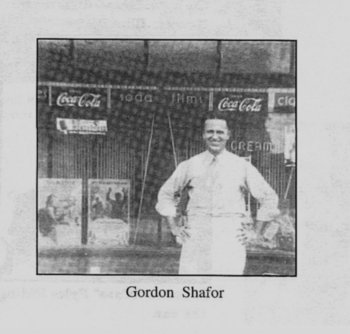
Mrs. Shafor enrolled in a correspondence course in pharmacy and managed the second operation. This is when I began working for the Shafors. She needed someone to help dip ice cream at the soda fountain. l was nine years old at that time. The store served the South side of town, but closed as did other stores with the approaching depression. Shafor's was more than a drugstore. It was a drop off station for St. Louis newspapers such as The Post Dispatch, The Globe Democrat, and Times. There were as many as seven paper routes; the carriers were grade school pupils. Telegrams were sent and received at the store. One time a message came which was to be delivered to an infamous character who had a shady background and supposedly was a big-time racketeer. l was to deliver the wire in person; truthfully, I was scared. I found him at curbside in front of the Franklin Hotel, handed it to him, and ran. The Royal Theatre, owned by Roy Clutts, had no concession stand, so Mr. Shafor purchased a popcorn machine which resembled a goodsized baggage trunk on wheels. It opened to prepare the popcon, which sold for a nickel a bag. The popper was rolled from the drugstore and set up in front of the movie house before show time. Once we witnessed a feud between the Progressive Mine Workers and the United Mine Workers Association when they engaged in a short gun fight during a meeting in the Miners' Hall. This was before the "hard road" was laid through Royalton, so there were ditches on each side of Main Street. The two opponents used the ditches as trenches, firing from one side to the other. Some of the bullets came through the windows of the drugstore, driving us to seek cover on the floor. The prescription counter, located in the back of the store for privacy, could not be seen by customers. Elixirs, tonics, extracts, expectorants, and ointments were compounded there. These were prepared for over-the-counter sales. Not too many prescriptions were filled because the medical doctors were dispensing physicians. I remember one ointment that was very messy and hard to compound. With a spatula, lard was spread on a pill tile and mixed with precipitated sulfur until smooth. It was used as a cure for scabies or, as It was called then, "the seven year itch." Also on the prescription counter was a huge book four inches thick entitled The United States Dispensatory which listed the formulas for the making of all these preparations. It was also used 'to hide" extra change and one dollar bills for use in the cash register. The South wall cases held the liquid medications, such as Swamp Root, elixir of Iron, Quinine and Strychine tonic, Witch Hazel and Glycerine Lotion, Lydia Pinkhams and Wine of Cardui. The pull-out drawers under the liquids stored the analegesic and laxative tablets and pills of all kinds, such as Quinine tablets, Hinkle pills, Partola, Cod Liver Oil capsules, aspirin and calomel tablets. One drawer was out-of-bounds for me. It was where the prophylactics were stored (then known as MerryWidows). None of the men customers would ask for them unless Mr. Shafor was there. The North wall was stocked with cosmetics, mostly Lady Esther face powders, Evening in Paris products, Ponds Cold creams, perfumed talcum powder in sift-top cans, and bulk perfume that was sold in drams. In the middle of the wall was a huge safe where liquor was kept. SPIRITUS FRUMENTI was available only on prescription during the prohibition days. No one knew the combination except Mr. and Mrs. Shafor. The Shafors were active in community affairs. They supplied the Booster baseball team with baseball bats. The took the paper boys to St. Louis for visits to the zoo, baseball games at Sportsman Park, and to the amusement park. They built a long toboggan-type wooden sled which held twelve persons and pulled it behind their car and over the snow-covered dirt roads between Royalton and New Bush. Working for the Shafors and observing Lottie as she studied her correspondence course lessons perpetuated the interest I had to become a pharmacist. I decided to go to Indianapolis and enroll in the Indianapolis College of Pharmacy, now ButlerUniversity. When the time came for me to leave, Mr. Shafor drove me to the Hoosier capital, located the school, waited until I was enrolled, and then helped me find a room and roommate near the campus. Working for Gordon and Lottie Shafor wasn't exactly work. It was enjoyable and educational. It was like being a member of their family, and eventually it rewarded me with fifty-five years in retail pharmacy. Tony Coppi |