|
(According to an interview given by Henry Rodenburg, I find the following story about Royalton). By Mary Alyce Kern
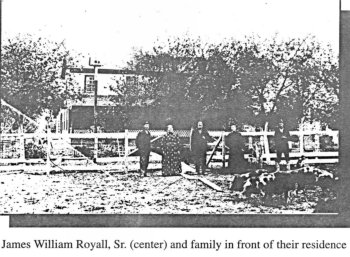
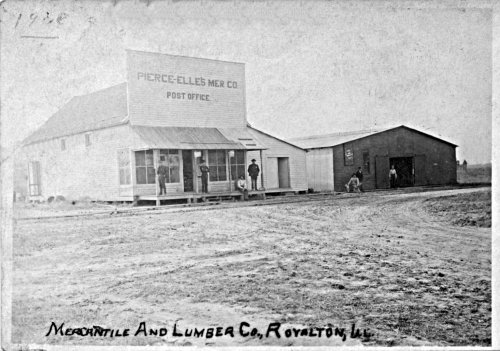
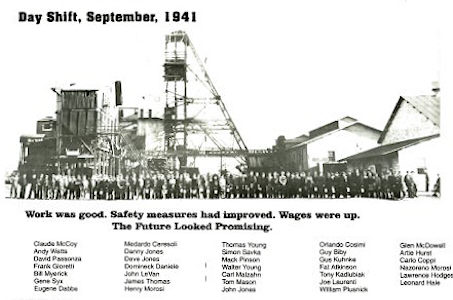
(Photo Taken From "The Eleventh Annual Royalton RoundUp 1995 Booklet Composed By Mary E. Stephens) Williamson County line. Henry Pierce laid out a village just north of the mine and named it Pierce. He set up a store and got Osage Post Office moved into his store and the name changed to Pierce. Mr. Pierce died soon after this and he had not recorded his survey. His widow, Elizabeth, recorded it November 3, 1905. John W. Royal owned the farm north of the Pierce farm. He had a village surveyed on his farm, September 30, 1905, and recorded that same day. The town was given the name Royalton.
Royalton was more vigorously promoted than Pierce. Soon James Tanner, known as Kelly Tanner, moved his blacksmith shop to Royalton, and Dr. c.M. Thornton moved from Osage to Royalton. Many others who had secured jobs in the mine came to villages nearer their work. The Pierce Post Office was moved to Royalton and the name changed to Royalton Post Office, May 24, 1910. Mr. Rodenburg says, "I came to Royalton in 1915. I worked at the Chester Penitentiary when we sold a little black horse that my wife's father had given her and I went to Undertaker's School in St. Louis. When I had finished I went to Herrin and worked for AK. Ellis. I drove a dray and delivered goods. Then the clerk's union came in to organize Herrin. I could not stay there because I did not have any work. We were on strike, so I went back to the farm. When the strike was over, Mr. Ellis told me there was no job for me, but as soon as one opened he would give it to me. But I got a job with John Stelsey. He had a hardware store in Herrin and one in Sesser. He sent me to Sesser and I worked in the hardware store and Mr. Stelsey had an undertaking parlor. I worked as undertaker. In 1915, I came to Royalton. I worked for Walter C. Creekhouse. He was a son-in-law to AK. Ellis. I was manager of the lumber yard and I also sold caskets. I did the embalming in a lumber shed. There was a pot belly stove in there and that is where I embalmed.
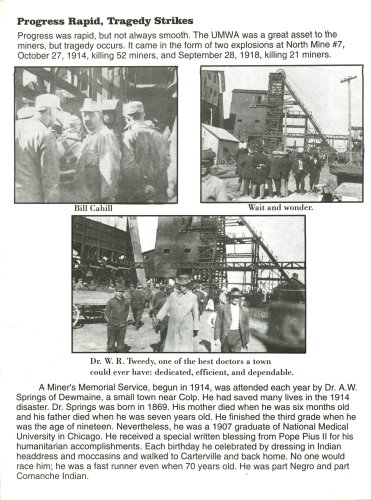
Then Mr. Creekhouse had the lumber yard and a hardware store. Bill Lovell was the banker. Royalton had a fine bank for a small town. Ed Harris had a livery stable. John Royal had a feed store just across Division Street from the Christian Church. "Kelly" Tanner had a blacksmith shop close to where the Russian Church stands. There were three or four grocery stores and eights saloons. Doctor Thornton moved to Royalton from Osage and practiced medicine here. Dr. Davis followed soon after. When Dr. Thornton died, Dr. Lewis came. Our last doctor to say any length of time was Dr. Tweedy.
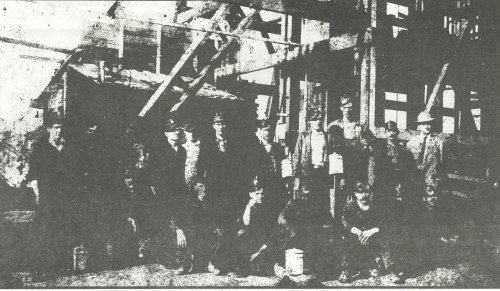
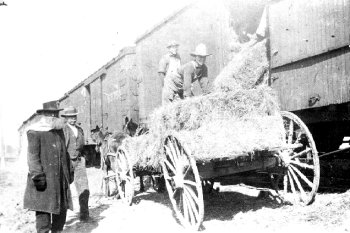
(Photo Taken From "The Eleventh Annual Royalton RoundUp 1995 Booklet Composed By Mary E. Stephens) Number Seven Mine was sunk just north of town in 1908. There were very few houses in Royalton at that time. Mr. Mitchell (the mine Supt.) bought several condemned railroad box cars and set them on a track, north of the mine. The people who worked at the mine lived in those cars. Then he built Hi Mary Row. This is the row of houses along the Mulkeytown town Road just west of the mine. The southern most house was a two story structure. It was a boarding house. Men who came here and got a job boarded there until they could get a house and move their family here. Then Mr. Mitchell built New Camp east of the railroad. He rented the houses for five dollars a month. They were four room two gable houses with third pitch roofs. Claud McCoy was the first man to live in New Camp. Mr. Creekhouse sold the lumber yard. I was his manager and I couldn't figure lumber. I never could see how they figure it. So my brother, Mr. AK. Ellis and I bought the undertaking and the hardware store. We rented the house back of the hardware for a funeral home. Old man Hearley drove the hearse. He charged me five dollars to haul a body to the cemetery. He would curry his horses and tie up their tails to get them ready for the funeral. Other times he hauled coal with them. I bought out Mr. Ellis and my brother and had the hardware store for myself. Then I built a bigger building and put the hardware store in it. I rented the old building to the government for a post office. For 30 years I got $32.50 a month for it. When the lease ran out I built the new post office. A man from Peoria, he is called the area man, came down here. He walked up and down the street. Then he said right here is where I want the new post office. I asked Bill Jocko what he wanted for 30 feet of that lot. He said a thousand dollars. I said, "Bill, you know no lot in Royalton is worth a thousand dollars." He said, "Well, I'll take five hundred." I gave him five hundred and built the new post office. The South Mine closed in 1920. It was a wet mine and it got to the place where it took all the profit to pump the water out.
(Photos Taken From "The Eleventh Annual Royalton RoundUp 1995 Booklet Composed By Mary E. Stephens) There were two explosions at Number Seven Mine. The first was on October 27, 1914, 52 men were killed and several injured. The hero of this disaster was Dr. Springs of Dewmane. There was constant danger of another explosion and some of the air in the mine was suffocating. Yet Dr. Springs said these miners down there need me. He went into the dangerous situation and worked with the injured. For this he received two gold medals from the U.S. Bureau of Mines. The second explosion occurred September 28, 1918. Number Seven was a gassy mine. Miners then had lamps that burned oil and were open flames. A fire started about four o'clock, quitting time, on September 27. A crew of men were sent down to fight the fire. About 5 a.m. the next morning, gas exploded killing 21 miners. and condemned to die. Bianci committed suicide in Williamson County jail. De Santi was hanged in February 1921. meeting in 1916 where the M.AT. factory now stands. 30 people were organized into Royalton Methodist Church. Holy Protection Orthodox Catholic Church was organized in 1914. The Royalton Baptist Church was organized in 1923. Saint Aloysius Roman Catholic Church was organized in 1919. The Royalton Church of the Nazarene was organized in 1925. The Old Pentecost Church was organized in 1920 and the New Pentecost Church was organized in 1940. The First Christian Church was organized in 1922 and the brick church built in 1924. There was a Lutheran Church but it never had enough members to support it. The Church of Christ is on the highway going west of town. in the old bank building for a long time. Ed Potocki built a modern store on the hard road going west. He sold it to Bob of Bob's Market when he retired. Charley Tavaggia of Herrin ran a store in Royalton every since the Second World War. He retired and closed the store a few years ago. John Lovelace was a grocer in Royalton for many years, operating the Clover Farm Store where flour, sugar, etc. were sold by the scoop When I retired I sold Royal Hardware to Alfred Moler who had been my manager for several years. Moler sold it to Wilburt Fiss and he changed the name to Royalton Hardware. I also sold the undertaking business to Moler for he is an undertaker. He sold it to Vantrease. There are two barber shops in town. One is run by Robert "Brick" Hardcastle, and the other by Bill Battle. There is Kings's T.V. and Kuhnke's Drug Store. Mary's Diner and a little lunch stand on North Main are the only restaurants. Isadore Cleaners is our only dry cleaner. There are two filling stations, Carl Baggett's and Bob Gaddis'. There are four taverns in Royalton: Mary's, Owner, Mary Covelli, Blue Front by Marion Regis, James Perryman and Ferrell Norman. The only pool hall is run by Wesley "Peck" Wilson. Smith bought some of the machines and started a plant to rebuild and repair them for resale. Smith sold his plant to M.A. T. Industries, Inc. They are the only industry in Royalton. They rebuild mine machinery. Royalton is a good place to live. I have been here for sixty years. |