|
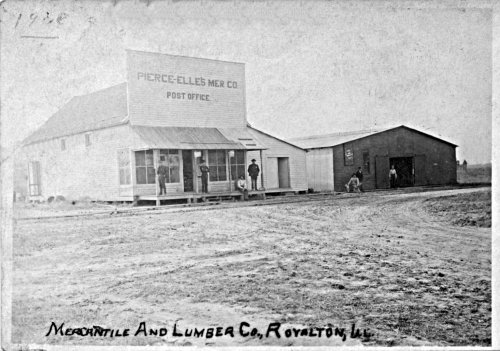
The first blacksmith was a German named Deler Stager. He opened a shop and operated it until 1905. Then he sold the shop to James Meridith Tanner and moved to Pulaski County. Tanner was known by a nickname "Kelly". He acquired the name from a Kelly family who took care of him while his father was in the Union Army during the Civil War. "Kelly" Tanner operated the blacksmith shop in Osage until 1915. That year he moved his shop to Royalton and located it on Fairdale Street just South of the Russian Catholic Church. The home of Lonnie Grammer stands on the lot now. Mr. Tanner closed the shop in 1918 and retired to Florida. Clarence Tanner, his son, still lives in Royalton. In 1890 Robert Dixon and his son James M. set up the second store in Osage. The post office was moved into the store and James M. Dixon became post master. The people of Royalton and Pierce came to Osage for their Mail. Osage Post Office was moved to Pierce on May 28, 1906, and the name was changed to Pierce. Pierce Post Office was moved to Royalton and became Royalton Post Office on May 24, 1910.
APPEARED IN SOUTHERN ILLINOISAN SUNDAY, FEBRUARY 28, 1971 BY: JOHN TRIMBLE, OF THE SOUTHERN ILLINOISAN
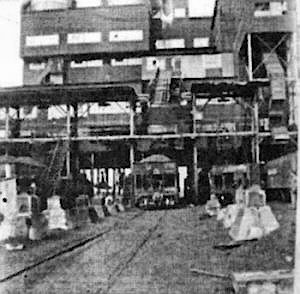
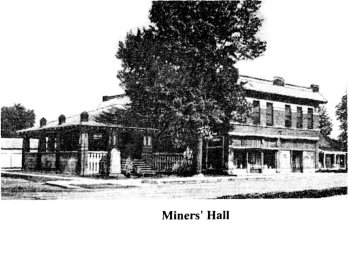
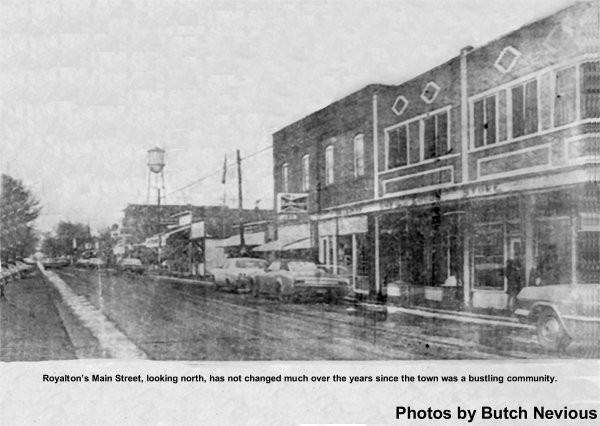
Royalton, sitting astride the coal country of Franklin County, has flourished and declined, with the mines. As in so many other Southern Illinois towns it was the coal mines that gave life to Royalton. Any discussion of the village inevitably leads to talk about the fate of the South Mine and Mine No.7, which lies just east of town. At one time, when the mines were in their heyday, Royalton boasted a population of 3,800, made up mostly of old-line county residents, Russian and Italian immigrants. The immigrants came to RoyaIton in the early part of the century looking for a better life and a job in the coal mines. The town grew and prospered with the influx of new people. There were eight taverns, a bank, a miners' union hall, a movie theater and numerous other businesses lining Main street, according to Henry Rodenberg, 86, a retired undertaker and hardware merchant in Royalton. But that was back in the "good old days" of the 1920s when the mines were going and Royalton was growing. Both mines are now defunct and have been since 1952. With the closing of Mine No.7, Royalton's population dwindled to its present 1,200 residents. Today there are only four taverns left. The bank closed years ago when the president made some unwise deals that resulted in the bank losing its money, Rodenberg said. Bellina's Bakery closed in 1923. Construction of Rt. 149 brought deliveries from larger bakeries and forced the Bellinas to close their bakery and open a dry goods store, according to Gena Bellina LeVan, owner of Bellina's Dry Good Store. The ovens of the old bakery can still be seen in the back of the store. The union hall, one of Royalton's finest buildings, still stands facing Rt. 149. The old movie house has been converted to a mine machinery repair shop. Residents of Royalton today depend on industry in surrounding towns and other coal mines in the area for their livelihoods. One industry left in the village is Royalton M.A.T. Industries, which employs about 40 persons, according to Rodenberg. The industry repairs mine machinery. Many Royaltonians are retired coal miners or people who were raised in Royalton and have returned to retire there. "The town presents a quiet, almost sleepy appearance to the visitor who comes for the first time. There is not much traffic on Main street, Rt. 149. There are not many shoppers bustling about the sidewalks and on closer inspection, the visitor finds that many of the old two-story buildings on Main street are deserted and apparently have been for some time. One of the most striking features of the town is the smoke-stack of old Mine No. 7. It once stood 300 feet high and belched smoke, letting passers-by know that it was part of a working, living mine. Because it has been struck by lightning several times, the smokestack is shorter now. It stands like a bleak, weathered monument to better times past. The business district strikes a Western air. Its low-slung skyline and overhang roofs, which shelter almost all the Main street sidewalks, give the appearance of a town somehow oddly misplaced from the old West. The serenity of Royalton today was not always the atmosphere of the little community. Persons living there today who remember the 1920s and the booming coal mines say Royalton was once the roughest, toughest town in Southern Illinois. "I come from the toughest town in the United States," is what Robert "Brick" Hardcastle, a semi-retired barber in Royalton, told his buddies in the South Pacific during World War II. He said they scoffed at his statement until he received a magazine in the mail telling of the bizarre murder of two boys in a woods near Royalton. "After they read that article, they paid more attention to me." Hardcastle concluded. The double murder, one of the most gruesome tales ever to come out of Royalton, involved two West Frankfort youths and a gangster organization known as the "Black Hand." according to a June, 1920, issue of "Front Page Detective" magazine. It seems that the 18-year-old boys were murdered in August, 1920, because the sister of one refused to take part in the organization's illicit activities, which, according to the magazine, were kidnapping and white slavery operations. The two boys allegedly were lured to their deaths by Settimi De Santis of West Frankfort. He persuaded them to go to Royalton to help him buy a used car. When they arrived in Royalton, he led them into a nearby woods, where the owner of the car was supposedly waiting. Another man, Frank Bianci, apparently shot them to death. The boys were buried in shallow graves and the hand of one, painted black with shoe polish, was left protruding from the ground. A miner hunting in the woods two days later found the bodies and reported his finding to Deputy Sheriff Frank Bowling in Royalton. The two men involved in the killing eventually were tracked down and brought to trial in December, 1920. The trial was in Marion because the bodies had been found in Williamson County. Bianci committed suicide before the trial ended and DeSantis was executed in February, 1921, for his part in the crime. Other not-so-pretty stories about Royalton include the two mine explosions at the Franklin County Coal Co. Mine No.7. The first explosion was on October 27, 1914. An accumulation of gas in the mine blew up, killing 52 men, many of whom were of Russian origin. The Russian Orthodox Church in Royalton, which was under construction when the disaster took place, was dedicated to the Russian miners who perished in the explosion. The church cemetery still echoes the names of many of the victims. It occurred on Sept. 28, 1918, when a coal fire at the mine ignited an accumulation of gas. Claude McCoy, who was working at the mine at the time, said the fire started around 4 P.M.. the day before the explosion, which occurred about 5 a.m. The men killed were trying to extinguish the fire when the explosion occurred, McCoy said. Rodenberg remembers when one of the first owners of old No.7 went down to Arkansas and recruited laborers to work the mine. "He brought them up here and there was not enough housing for them", he said, "So they built a rail track and provided housing in boxcars right beside the mine." Later, a miners' camp was built near the mine to absorb the swelling ranks of miners flowing into Royalton from near and far. At one time, the mine employed 625 men. Royalton is not an old town as towns go. It was started in 1905 when J.B.Scott surveyed the area and laid out lots for the town. Originally, there had been a little settlement called Osage, which dates back to 1857. It was little more than a trading post, according to Glenn Sneed, a resident of Royalton who had done research into its past. He said a man named C. W. Thornton was the outstanding citizen of the old Osage community. He was a doctor, druggist, politician, postmaster and practically everything else to the settlement. Later, the little community of Pierce grew up when the South Mine was first sunk. Royalton eventually absorbed Pierce. The town was named after J. W. Royal, who owned the ground when it was firt surveyed. South Mine was sunk in 1906 and closed in 1920. Walter Schmitt, 8O, a lifelong resident of Royalton and coal miner for many years said the mine was closed because of water seepage. Another mine about one-half mile from South Mine was opened in 1949 and called the Lyda B. mine. It closed in 1952, shortly after Mine No.7 closed, according to McCoy. Mine No.7, apparently the most prosperous of all the mines near Royalton, was sunk in 1908 and was worked until 1952. Rodenberg said the mine closed because of poor management. Royalton has lived a fairly jubilant life from its beginning through the rough and tumble coal mining days until now. But what of the future? There are rumors floating around the town that a new mine will be opened northwest of Royalton. Who knows? Royalton may see lively days again. ROYALTON IN 1914 ARTICLE TAKEN FROM FRANKLIN TODAY PAPER BY : Dianne Throgmorton Southern Illinoisan Correspondent Appeared in 1983 It was the first nice, clear, frosty morning they had that fall of 1914, October 27, a Tuesday much the same as usual at the Franklin County Coal Company's Mitchell Mine in Royalton. The last cage was just going down into the mine, and as it started down, a second cage came up to ground level. The young company weighman, Walter Schmitt, got on the empty cage and rode up to the tipple. He went onto a big box to bring the checks in and stepped off into the weigh room. There were 12 to 14 men on the last cage. Schmitt heard pieces of coal and debris hitting the bottom of the cage and shouted, "Get off, fellows! Get off!" Schmitt, now 92, graphically described the incident. "They jumped off the sides and back and everywhere, and that smoke was just thick. It left a coating of coal dust over all the tipple and it went about 50 feet higher than the tipple and never spread out a bit. Just straight up - just dark, black smoke. " Schmitt left his wife and 12-day-old baby at home that Tuesday to go to work, and it was late Friday night before he returned. The rescue crews worked straight through the days and nights that followed the death-dealing explosion, but the effort was worthwhile. . Three hundred and thirty-seven men were down in the mine at the time, and though 52 lost their lives, the death toll could have been much higher. Schmitt credits quick thinking for the number of survivors. "When the explosion occurred, they reversed the fans," he explained. "There were no man trips back then. Every man walked in. It was before starting time, and they figured that no one yet had got to their work place. The miners were on the main line walking in, and the main line was the turn of the air. So we reversed the fans to put fresh air on the men that were going in. "Some of the men on the bottom were already unconscious," added Schmitt. "They would have been dead in a half a minute, but when the fresh air hit them, they got another breath and they made it." Schmitt believes that reversing the fans saved hundred of lives that day, just as he believes that the frosty October morning caused the explosion to be so violent. "The nice, cool weather came on, and the gas mixed with oxygen as it went down and caused a real explosion," Schmitt claimed. "The first rescue team arrived in a very short time," he said. "It was a team from Number Nine led by Dr. Springs, and he was the first and only doctor who went below to administer first aid to the crippled and wounded and help to bring them up. "Nearly everyone in town was there - some sight-seeing, but all were scared to death. Most everyone who lived in Royalton had someone down in the mine. "I had to do all the identifying, you see, because I had all their check numbers and I knew lots of them. I identified some by their features, some by gold teeth, some by scars, some by the clothes they wore, and some by the check numbers they still had in their pockets. "There's no question about it. There wasn't a mistake made in the identification." The men couldn't be identified as they came up because they were covered with coal soot and some were badly burned. Schmitt described the make shift morgue that was set up in a building near the mine. "They drilled holes in the floor and laid the bodies out and turned the hose on them to wash the coal soot off before they could be identified." It had to be done that way because there were so many bodies that were unrecognizable and not enough room. As they were identified, the bodies were claimed by relatives and taken away. "At one time," Schmitt recalled, "there were 32 hearses and wagons going out of town at the same time on the road to Herrin". Schmitt believes that the mines were fairly safe back then. Explosions weren't all that common. The only previous explosion that he could remember was at Number One mine in Zeigler in 1905. Royalton was a growing town in 1914. Schmitt remembers that there were more stores than there are now. The mine was fairly new and everything was done by hand. Most hauling was done by mule. When J. L. Mitchell first opened the mine in 1908, there were not enough workers, so he recruited men from Arkansas and Alabama and brought them up on the Iron Mountain Railroad which ran through Royalton. Finally, Schmitt recalls, workers were arriving faster than jobs were available, so Mitchell built a long building to feed and house the new men until a place opened for them in the mine. There were many workers of Russian descent, and when Russian holidays came along there would be so much absenteeism that the mine would have to blow over work that day. The Russian Orthodox Church, when completed, was dedicated to the Russian miners who lost their lives in the explosion of 1914. Schmitt was still working at the mine when a second explosion occurred on September 28,1918 - but he missed that one by one night. "I was working below then with the electricians," he recalled" and a fellow by the name of Noah Stevens worked with me. We had worked the night before. They were wanting the power cut off and said "Go get Walter and Noah Stevens to cut the power off." But someone spoke up and said, "No, they worked last night. Get somebody else." They got a fellow named Dittlerline, and he started into the mine. He just got halfway in when the thing exploded and killed him." Asked if any other survivors of the 1914 explosion are still around, he said, "Don't know another one. " The mine continued to operate until 1952 when it was closed permanently. The old smoke stack is still standing at the north edge of Royalton and can be seen from Illinois 149, which runs through the town. It's shorter now, and deteriorating, but still a silent reminder of days gone by. |